
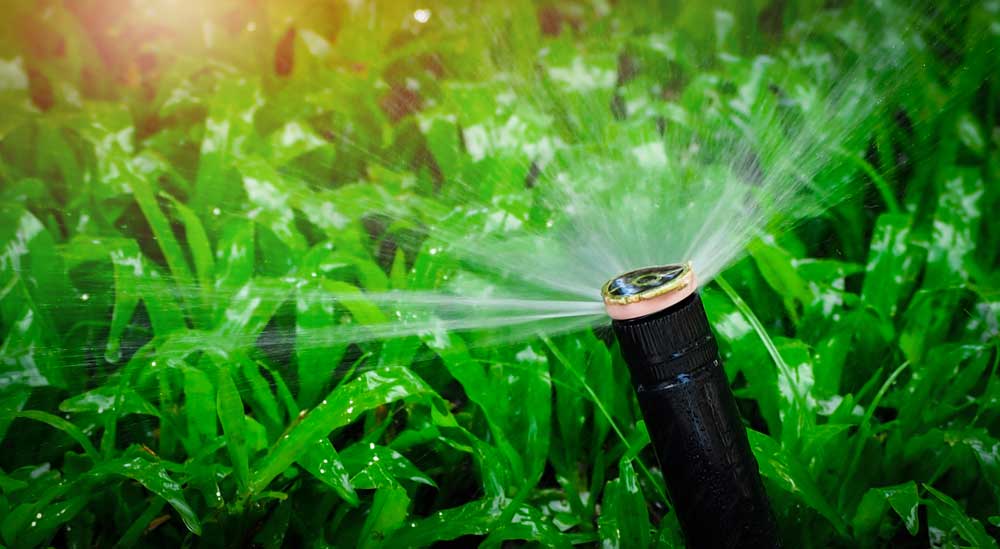
Dry spells in Australia rarely arrive as a single bad month. They build across seasons, and recovery in WA can be slower than the first green flush suggests. The Bureau of Meteorology notes that even after improved rainfall, deeper soil moisture, groundwater and streamflows often need sustained rain to recover, particularly across the south west of Western Australia.
Agriculture accounts for most of Australia’s water consumption, and in WA this is closely managed through groundwater licensing and allocation limits. As a result, the pressure to tighten water use is not going away. For small properties around Perth and regional WA, practical irrigation sprinklers and drip systems are being re-evaluated as reliable options that can be tuned
Why sprinklers still stack up
Sprinklers remain common because they’re flexible. They cope with irregular blocks, mixed soil profiles and a wide range of crops, and they fit the way many Perth growers already operate. The trade-off is familiar: wind drift and evaporation can strip away applied water, especially when systems throw fine droplets into hot, dry afternoon conditions common in WA summers.
Low-flow tech, translated into paddock terms
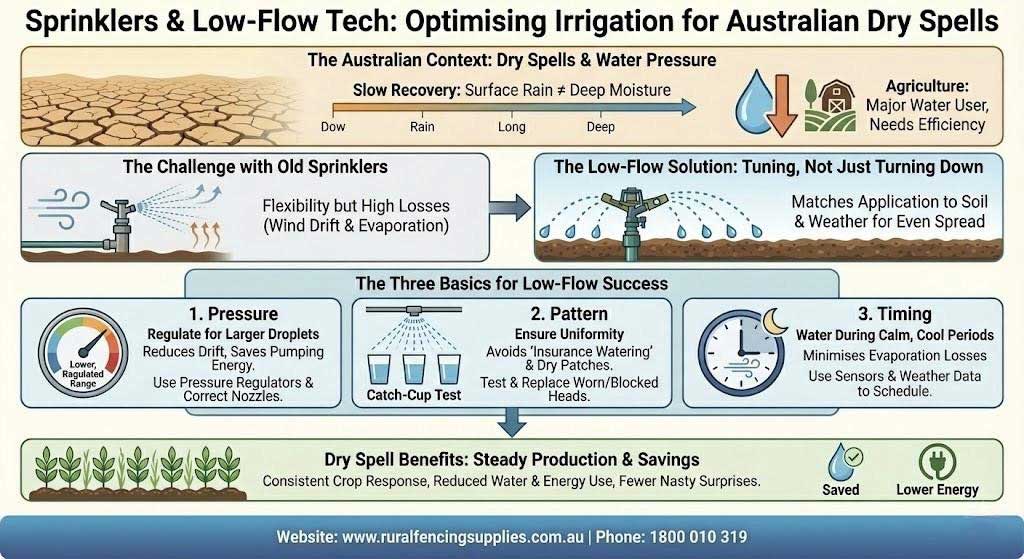
Low-flow isn’t just turning the tap down. It’s about matching application rate and droplet behaviour to soil intake and weather, while keeping coverage even. The best results usually come from three basics:
- Pressure
- Pattern and
- Timing
1. Pressure first
Many older systems run higher pressure than needed, which increases pumping costs and produces smaller droplets that drift more easily. Using the right pump, pressure controller and mains pressure rated pipework such as blue line poly can help maintain steady flow. Clean filters and correctly sized nozzles also keep each sprinkler operating within its intended range.
2. Pattern next
Uneven application pushes property owners into “insurance watering”, where run times are extended to cover dry patches. That can mean some areas become waterlogged while others still miss out. A simple catch-cup test is a practical way to assess distribution and identify blocked, worn or mismatched heads.
3. Timing rounds it out
Watering into strong afternoon winds is a recipe for losses in Perth’s coastal and inland districts. Shifting runs to calmer periods, lowering sprinklers where practical, and avoiding ultra-fine sprays can significantly improve efficiency. Drip lines connected with black poly pipe or white reticulation pipe can also reduce overspray in garden beds and around sheds.
Once the hardware is performing properly, measurement tools can refine scheduling. Basic controllers and flow monitoring help reduce guesswork and avoid irrigating out of habit. For many small properties, keeping storage tanks topped up and ensuring pumps are sized correctly is just as important as adjusting spray patterns.
What this means during a dry spell
In a dry spell, the aim is steady production with fewer surprises. Well-set irrigation sprinklers for farming and drip lines can support that goal when they deliver uniform water, limit drift and avoid unnecessary pressure. The benefit isn’t only water saved; it can also reduce energy use and support more consistent plant performance across the block.
Upgrades & Tune-Ups that Save Water
Western Australia adds its own mix: persistent winds, sandy soils in many Perth and Wheatbelt areas, and groundwater rules that can tighten quickly under the Department of Water and Environmental Regulation. Routine maintenance and controller settings that align with local conditions and allocated watering days are essential.
For anyone reviewing farm irrigation sprinklers, start with the basics: confirm end-of-line pressure, replace worn nozzles, clean filters, and ensure each zone suits the crop, lawn or garden area. Retest after changes and adjust runtimes accordingly.
Also Read: 5 Reasons Why Automated Irrigation is the Future of Climate-Resilient Farming
Frequently Asked Questions
- How is irrigation affected by drought?
Drought reduces rainfall, soil moisture and streamflows, so allocations tighten and on-farm storages and water tanks refill slowly. Hot, dry air can increase plant water demand, making timing and even coverage more critical.
- What is the irrigation method of sprinklers?
Sprinkler irrigation uses a pump and pipe network to deliver pressurised water to heads or nozzles that spray droplets over lawns, crops or soil. Systems typically include fixed lines and simple portable setups suited to small properties.
- Do low-flow sprinklers reduce yield?
Not by default. If coverage remains even and run times match plant demand, low-flow systems can maintain growth while reducing drift and excess pressure. Issues usually arise from poor spacing or blocked nozzles.
- What’s the quickest way to check if my sprinklers waste water?
Conduct a catch-cup audit and compare applications across the zone. Large differences often indicate blocked heads, worn nozzles or mismatched sprinklers.
- Where should I spend first when upgrading?
Measure before buying: check pressures and uniformity, then prioritise filtration, pressure control, nozzle condition and controller settings. Upgrading pipework to red line rural pipe for dams and bores, or blue line for mains pressure applications, can also improve reliability. For parts, fittings and practical advice suited to Australian conditions, shop the irrigation range at Rural Fencing Supplies.
Leave a Reply
You must be logged in to post a comment