Choosing the right mesh format is often the difference between a fence that suits the site and one that becomes harder to install than expected. If you are comparing welded mesh rolls vs. panels, the decision comes down to three things: the shape of the area, the finish required, and the amount of labour involved.
Key Takeaway:
If you want the short answer, it is this:
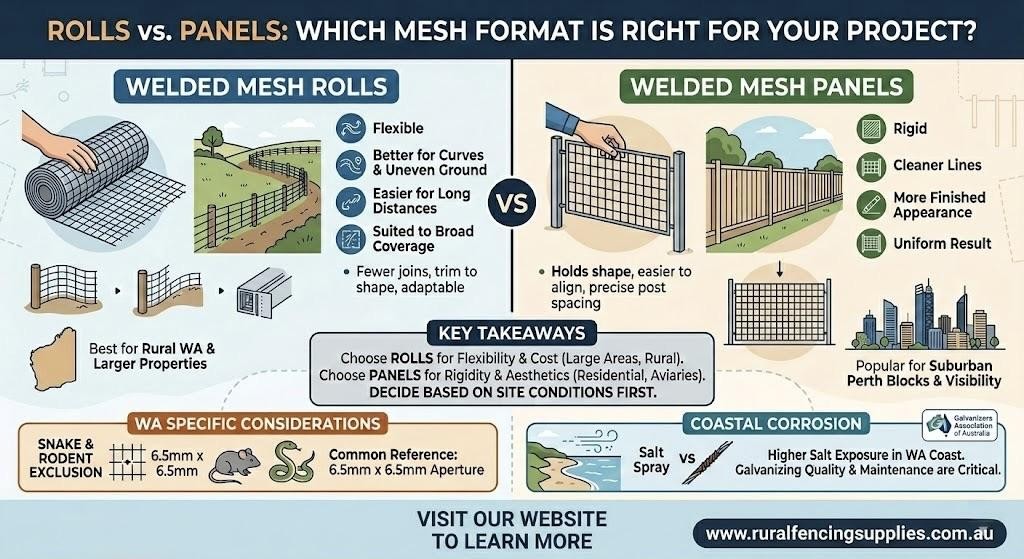
- Choose rolls when you need flexibility, longer coverage, and a more adaptable material for uneven or awkward ground.
- Choose panels when you want rigidity, cleaner lines, and a more finished appearance.
- Choose based on the site first, not on what seems quicker in theory.
That basic split holds up across most residential, rural and small property projects in WA, especially where fencing needs to balance practicality with cost.
Welded Mesh Rolls vs. Panels at a Glance
At a practical level, the main differences are easy to spot:
- Rolls are flexible
- Better for curves, corners and uneven ground
- Easier to transport in longer lengths
- Usually suited to broad coverage rather than a polished finish
- Panels are rigid
- Better for straight runs and framed sections
- Easier to align evenly between posts
- Usually give a neater, more uniform result
- Rolls tend to need more handling during installation
- They must be set out carefully
- They may need tensioning to avoid sag
- Panels demand more precise spacing
- Post placement needs to be accurate from the start
- Standard sizes can be less forgiving on irregular layouts
What Works Best for Perth and WA Properties?
In Western Australia, the location and use of the fence often decide the format before price does.
- On larger properties, rolls often make more sense because they cover distance efficiently.
- On suburban Perth blocks, panels can be a better match where the fence is visible and appearance matters.
- For mixed-use spaces such as garden edges, pump areas, water tanks or small animal enclosures, either format can work if the aperture and wire are suitable.
Rolls remain a popular general purpose mesh in WA for broad-use fencing.
When Mesh Rolls Are the Better Choice
Rolls are often the better fit when the project calls for flexibility rather than precision.
- Best for:
- Long fence lines
- Uneven ground
- Curved or irregular layouts
- Lower-cost functional fencing
- Many DIY fencing projects
- Why they work well:
- Fewer joins over longer distances
- Easier to trim to unusual shapes
- More adaptable around existing posts, garden beds or structures
- What to keep in mind:
- A good result depends on careful setup
- A rushed install can leave the mesh loose or uneven
When Mesh Panels Are the Better Choice
Panels suit projects where presentation and structure carry more weight.
- Best for:
- Straight residential runs
- Aviaries and framed enclosures
- Gates and partitioning
- Utility enclosures around pumps or equipment
- Why they work well:
- They hold their shape
- They are easier to keep level
- They often look cleaner once installed
- What to keep in mind:
- Standard panel sizes do not always suit custom dimensions
- Poor post spacing can create extra cutting or wast
Weld mesh panels are suitable for bird aviaries, gates and enclosure areas, especially where the fence forms part of the visible finish of the property.
Cost, Installation and Local Conditions
The choice is rarely about material cost alone.
- On price
- Rolls are often cheaper across large areas
- Panels can be more expensive per metre
- Panels may still save time on short, simple runs
- On installation
- Rolls usually need more hands-on setup
- Panels are easier to position but less flexible if measurements are off
- On tools
- Tensioning matters more with rolls on longer runs
- Wedgelock clamp is used with wire strainers to clamp onto wire while the strainers evenly tension prefabricated wire
- On local conditions
- In coastal WA, salt exposure increases corrosion risk
- The Galvanizers Association of Australia notes higher corrosivity close to the coast, especially in surf shoreline and nearby sea-shore zones.
Mesh Size for Exclusion Work
If the goal is exclusion rather than just fencing, mesh opening size matters more than format.
- For snake and rodent control, a common reference size is 6.5 mm x 6.5 mm
- This size is widely used across Australia for pest exclusion
A small aperture only works well if the install is tight at the base, corners and gates
How to Choose the Right Mesh for Your Project
A simple way to decide is to work through the job in order:
- Choose rolls if you need reach, flexibility and better value over a larger area.
- Choose panels if you need a firmer, straighter and more finished-looking result.
- Choose smaller apertures if pest or snake exclusion is part of the job.
- Choose suitable galvanising if the property is near the coast or exposed to salt air.
The best outcome usually comes from matching the mesh to the site conditions, not from forcing one format to cover every kind of project.
Frequently Asked Questions
Is it cheaper to buy mesh rolls or panels for a large backyard?
In many cases, yes, rolls are the cheaper option for large areas because they cover longer distances with fewer joins. Labour can shift the numbers on very simple, straight sites, though rolls usually remain the more economical starting point.
Do I need a tensioner to install welded mesh rolls?
Not in every case, though a tensioner often improves the finish. On longer runs, it helps keep the wire taut and reduces sagging, which makes the fence look more even and perform better over time.
What is the best mesh size for snake-proofing a property in Perth?
A 6.5 mm x 6.5 mm mesh is a common starting point. It is widely used for snake and rodent exclusion in Australia, though the final result still depends on proper installation and sealing gaps at the base.
How long does galvanised mesh last in coastal Western Australia?
There is no fixed lifespan because coastal exposure varies. Salt, wind direction, shelter and drainage all affect corrosion rates. In general, mesh near the coast needs closer attention to coating quality and maintenance than the same product inland.
Are mesh panels better for a neat residential finish?
Often, yes. Panels are easier to align, hold a straighter line, and tend to look more consistent once installed. That makes them a strong choice where the fence is clearly visible and appearance matters.
Leave a Reply
You must be logged in to post a comment.